Blockhead
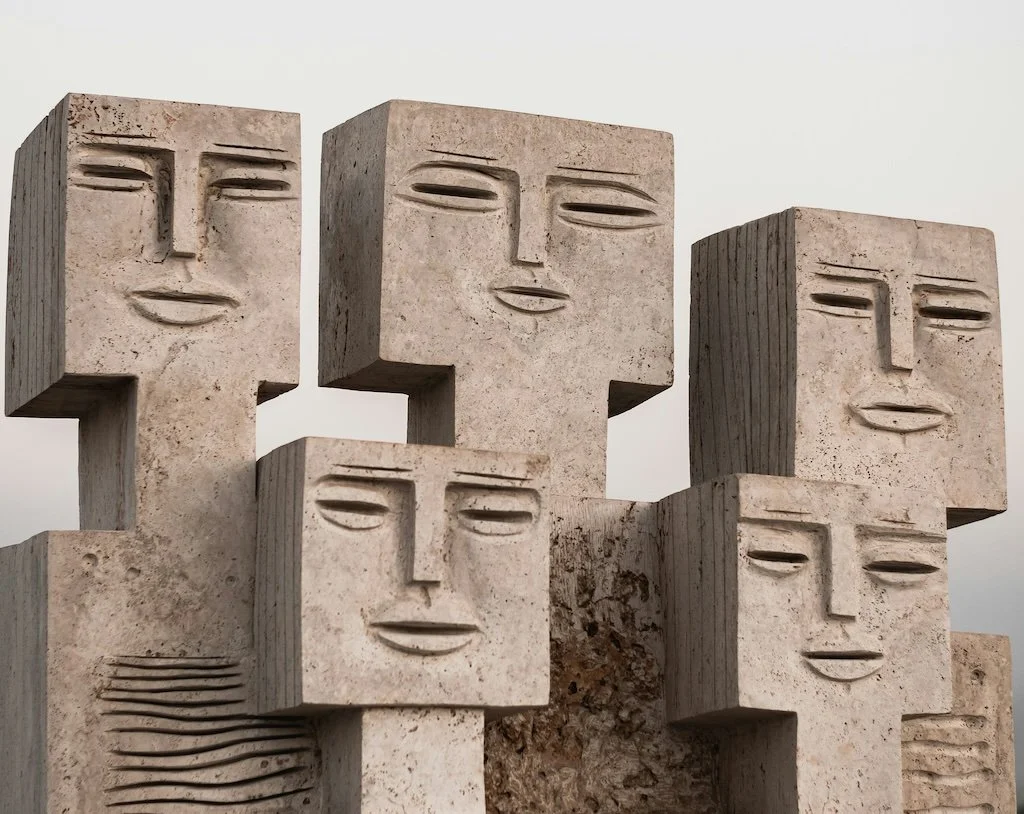
Image Description: A statue that features heads shaped into blocks. Image courtesy of Ashkan Forouzani on Unsplash
I know it’s been more than a minute since my last blog post. Maybe you haven’t missed me. But I have missed me. I have long been a forgiving sort who writes about giving oneself grace when not actively creating and embracing zig-zag approaches to the creative process. I even wrote about ways to stretch those creative muscles when you are feeling stuck.
But what happens when you reach an existential block?
That is a bit how I’ve been feeling for the past few months. My most recent book event was in the summer. I keep saying I am going to get back into a documentary film I started before the pandemic. I started making some notes about a new book idea. I keep trying to get my creative juices going by doing everything from taking walks, listening to music I haven’t tuned into in years, painting rocks, paper (but not yet scissors), and trying to stay attuned to what other artists are up to, including in disciplines that are different from my own. I spent 30 days on a social media experiment where I posted an image that brought joy to me every day for 30 days. It forced me to seek out those small moments of joy, document them, and share them. I didn’t think of it as a creative project per se, but I guess it was.
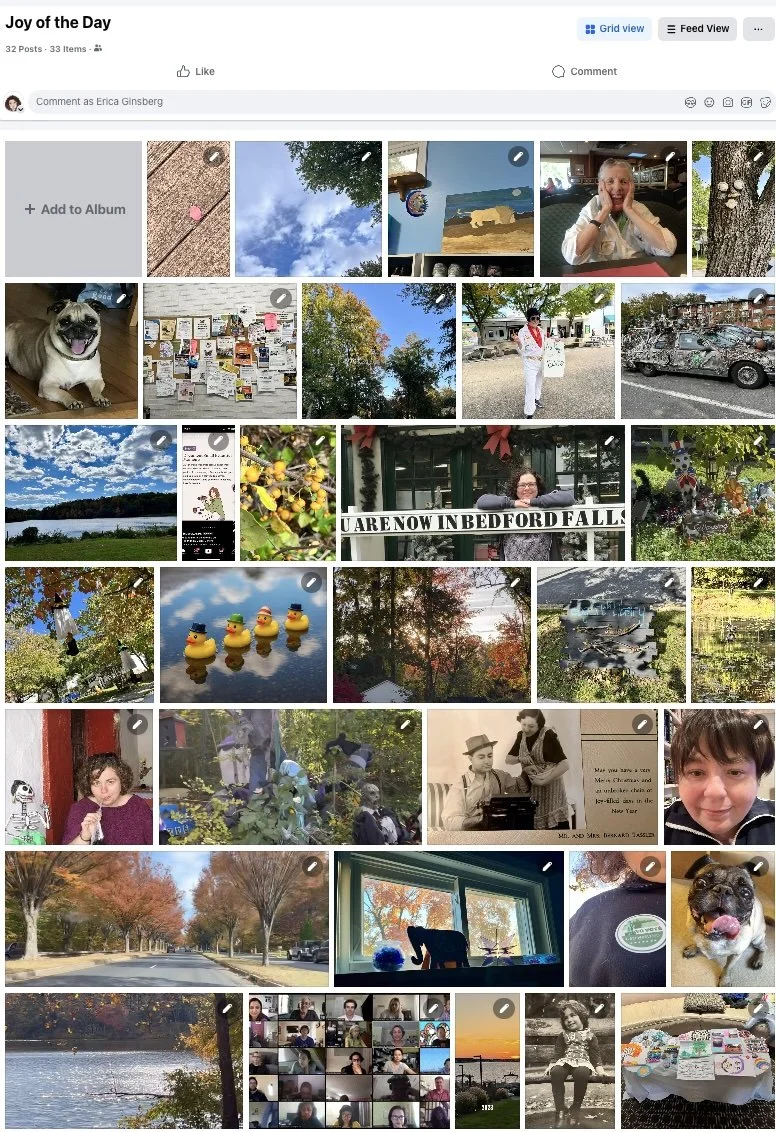
Image Description: A collage of social media images that make up the author’s “Joy of the Day” project where she posted an image every day for 30 days that brought her joy
The final few weeks on the calendar can be challenging in normal times when we are reflecting on what we’ve achieved (or haven’t) in the past year. Add to that a state of the world that is exhausting and heavy on so many levels. Worrying about whether you can progress creatively feels like such a privilege in the times in which we live. And yet this is when we most need to find ways to express ourselves, whether to make an impact or simply to remind ourselves of our own humanity.
[Insert the sound of car breaks]
That is as far as I got with this blog post for about the past two weeks. Sitting in my home office, I kept this draft open but untended to. Even this was starting to feel like a heavy lift. How could I turn this exasperation into inspiration? For you? Or even for myself? It can feel foolish sometimes to be doling out advice to others on how to navigate the ups and downs of the creative process when I feel so stuck in my own creative pursuits.

Image Description: The author’s tabs across the top of her laptop. 16 tabs is actually a pretty small number for me. But this Blockhead post has lived open in progress (or lack therof) on my laptop for the better part of a month.
Coming back to this open tab on my laptop, I stared at what surrounded it: work papers, a semi-organized but seemingly messy pile of financial documents for both me and my mother (whose finances I am now handling). Hardly the stuff that inspires. But then I turned my head to the wall where I posted my vision board for the year. As the year is coming to a conclusion, I wanted to revisit my hopes from the beginning of the year, a time which feels like a lifetime ago.
Right in the middle was something that said, “The best way out is always through.”
Words of wisdom from poet Robert Frost who was also a human artist who contended with his own challenges of the creative process.
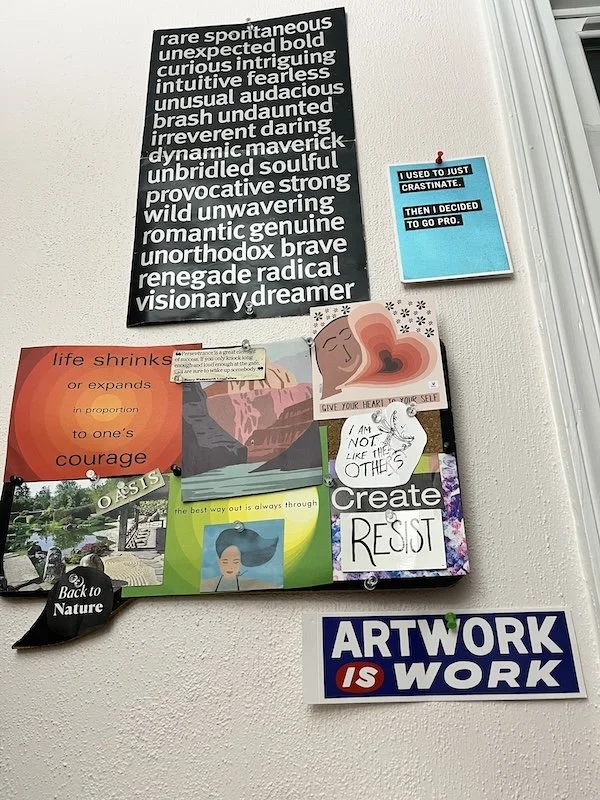
Image Description: The author’s inspiration wall that is a mix of images and words, including a 2025 vision board that contains the quote “The best way out is always through.”
That line reminds me of one of the central points I always make about creativity: Our first thought should not be to find hacks and easy answers to avoid the challenges. It is about accepting that challenges are central to the process. We may not all navigate them in the same ways or at the same pace, but they must be navigated nonetheless.
And just because I provide some advice on navigating the creative process doesn’t exempt me from needing or listening to my own advice. Sometimes we are hardest on ourselves because we don’t reflect what we think the world should see in us.
And yet sometimes the world sees in us things we might overlook.
I was recently conversing with a former work colleague who I had not seen in many years. He eagerly told me how influential my love of documentary film had been to him. He proudly noted how he had become involved with getting a documentary made and seen and said that I had an influence on that direction for him. I have no memory of us having ever discussed documentaries when we worked together or that doing so would leave such an impression with him. But hearing this from him made me realize how much of an impact we can have in small ways that might seem inconsequential.
It made me want to finish this blog post. Not because I have come to some great magical breakthrough in my own creative process or have some exceptionally sage advice to convey to you about art-making and the meaning of life. But just maybe there is something in these words that resonates with someone reading this. Could it help you find a path forward? Or at least a knowledge that, even stagnation can be a shared experience. Sometimes the micro-actions that we may not even perceive as actions are what move us forward rather than the giant leaps.
May the rest of this year be kind to you and you be even kinder to yourself.
If you stumbled upon this blog entry on the Internet or got it from someone else forwarding you a link, please consider signing up for Erica Ginsberg’s mailing list so that you will get the next entry in the Creative Resilience series right to your Inbox. And, if you like the blog, check out the companion book.